
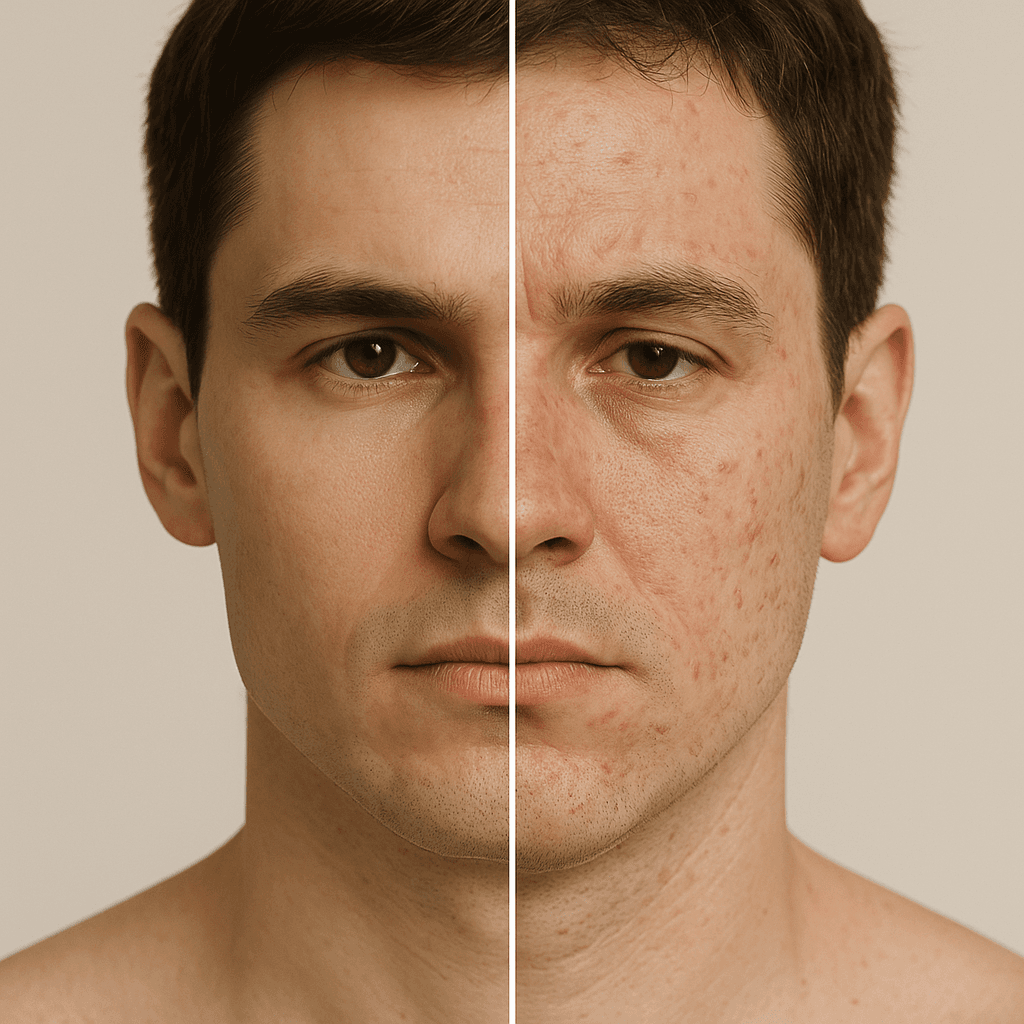
Skin Quality as a PSL Input
The PSL rating system breaks facial attractiveness into components — bone structure, eye area, jawline, skin quality, hair, and overall harmony. Skin quality is not a minor sub-variable. In community rating threads, evaluators routinely weight skin as the factor that separates a 6 from a 7, or drops a theoretically well-structured face into a lower tier because the canvas it's sitting on undermines everything underneath it.
The AI looksmaxing tools are explicit about this. Umax, PSL Scale, and similar apps all score skin quality as a discrete category. The breakdown in the community's tier model looks roughly like this:
- Normie tier: Noticeable blemishes, uneven tone, minor texture issues — skin is a net negative on the overall rating
- High Tier Normie: Few noticeable blemishes, minor imperfections — skin is neutral
- Chadlite: Clear skin, minimal scarring — skin is a net positive, stops being a deduction
- Chad and above: Virtually no visible blemishes, even tone, subtle glow — skin actively elevates the face
The ceiling on your PSL score if your skin is mid is real. You can have excellent bone structure and still ceiling out at a 6.5 because your skin is dragging the average down. This is what makes skin improvement one of the highest ROI moves in looksmaxxing — it's a direct multiplier on whatever structure you have, and it's more movable than bone.
What Bad Skin Does to Good Structure
Skin interacts with underlying structure in ways that most people don't think about explicitly. The face reads through shadows, edges, and planes — and skin quality determines how clearly those features project.
Loose, thin, or inflamed skin physically blurs edges. A well-defined jaw looks softer when the skin over it is lax and slightly puffy. High cheekbones look flatter when the skin lacks density and doesn't hold tightly against the bone. The shadows that define facial structure — under the orbital rim, beneath the cheekbone, along the mandible — rely on the skin sitting snugly against what's underneath. When it doesn't, the three-dimensionality of the face collapses in photos and at conversational distance.
Chronic skin inflammation is the other hidden variable. Low-grade redness, reactivity, and uneven tone flatten facial contrast. Contrast is what makes features distinct and memorable. A face with high contrast — clear, defined features against good skin — registers as more attractive than the same bone structure on a flat, inflamed baseline. This is not subjective: it's how facial geometry gets read by the visual system.
This means skin improvement is not just cosmetic maintenance. Done right, it directly amplifies the structural gains you're already working on through everything else.
The Periorbital Problem
The eye area gets more attention in looksmaxxing than any other single feature. Hunter eyes, canthal tilt, orbital rim projection, scleral show, limbal rings — the community has developed a granular vocabulary for it because it matters that much. But a huge percentage of the eye area discussion ignores the skin component, which is a mistake.
The periorbital zone is where skin quality issues concentrate and where they have the largest impact on perceived attractiveness. The skin there is the thinnest on the face — roughly 0.5mm compared to 2mm elsewhere — which makes it the first to show:
- Under-eye puffiness from fluid retention and inflammation
- Dark circles from vascular visibility through thin skin
- Fine lines and crepey texture from collagen loss
- Hollow tear troughs from volume and density loss
Each of these directly affects how your eye area reads. Puffiness reduces the definition between the lower lid and the infraorbital bone. Dark circles create shadow patterns that look tired and aged regardless of canthal tilt. Crepe texture makes the area look older than the rest of the face. And none of this is fixed by mewing — it's a tissue quality issue that requires a tissue quality solution.
The infraorbital bone is the structural foundation under the eye. Weak infraorbital projection is a structural problem, but even good orbital projection looks worse when the skin over it is thin, loose, and inflamed. Improving skin density and tightening the periorbital tissue is one of the clearest returns in the space because you're not fighting genetics — you're just removing what's actively obscuring the structure you have.
Jawline and Skin Laxity
Body fat percentage is the most commonly cited variable for jawline definition — most people see meaningful improvement getting from 18% to 12–14% body fat, where the mandibular line sharpens and facial planes separate. But skin laxity is the piece that persists even at low body fat, and it's underrated.
Lax skin along the jaw and neck softens the mandibular line. It rounds what should be an edge. At 12% body fat with poor skin density, the jawline still looks softer than it is — the skin isn't holding tight enough to the bone for the underlying structure to project properly. This is more common in people who cut quickly from higher body fat, where the skin hasn't had time to remodel, but it also just accumulates with age as collagen degrades.
Tightening the skin along the jaw — increasing density, firmness, and the structural collagen that holds skin against bone — is a direct looksmax for the mandibular line that operates completely separately from body fat manipulation.
The Baseline Softmaxx Skin Stack
Before anything else, the foundation has to be in place. This isn't complicated, but skipping it and jumping straight to advanced interventions is a waste.
- SPF 30–50 daily, no exceptions. UV exposure is the primary driver of collagen degradation and photoaging. Every other intervention you run is partially undermined if you're exposing your face to UV without protection. This is the single highest ROI move in skincare and the most ignored by guys.
- Tretinoin 0.025–0.05% — the only topical ingredient with robust clinical evidence for actually reversing photoaging, not just preventing it. Increases cell turnover, stimulates collagen synthesis, and improves texture over time. Expect 12+ weeks before visible structural improvement.
- Niacinamide 10% — reduces pore appearance, improves skin barrier function, suppresses inflammatory pathways, and evens skin tone. Works fast (4–8 weeks for visible tone improvement) and stacks cleanly with everything else.
- Vitamin C serum (L-ascorbic acid 10–20%) — antioxidant protection, mild collagen stimulation, slight brightening. Best used in the morning under SPF.
- Hydration: Hyaluronic acid and a solid moisturizer. Not the headline intervention but skin that's properly hydrated reflects light better, shows texture less, and responds better to actives.
This stack handles the baseline — protection, cell turnover, barrier health, and tone. Run it consistently for 3 months before evaluating results. Most people who say skincare doesn't work are either inconsistent or haven't given it enough time.
Why Retinol Alone Isn't Enough
Tretinoin and retinol are excellent for cell turnover and surface-level texture. The problem is they don't directly address structural collagen loss — the deep-layer density decline that causes skin laxity, loose periorbital tissue, and the reduced "tightness" of skin against bone that blurs facial structure.
Tretinoin stimulates collagen synthesis indirectly through cellular turnover. The effect is real but limited to the upper dermis and takes years to produce meaningful structural changes in deeper layers. It also doesn't touch the extracellular matrix scaffolding — the glycosaminoglycans, elastin, and structural proteins that determine how dense and firm skin feels and behaves.
This is where the gap is. The baseline stack handles surface quality. To move skin density, firmness, and the structural tightness that actually affects how your facial features read — you need to go deeper into the mechanism.
Where Peptides Come In
Peptides are the intervention that bridges the gap between surface skincare and structural tissue change. Not all peptides are the same and most of the peptide serums sold in mainstream skincare are underdosed and use peptides with limited evidence. The relevant ones for looksmaxxing purposes are those with documented effects on collagen architecture, ECM remodeling, and skin density — not just temporary hydration or surface smoothing.
The mechanism matters: signaling peptides work by triggering fibroblast activity — the cells responsible for producing collagen, elastin, and the structural proteins of the dermis. Unlike retinoids, which force cell turnover, peptides that hit fibroblasts directly stimulate the production of new structural material in the deep dermis. The two pathways are additive, which is why the best protocols run both.
For the looksmaxxing goals outlined above — periorbital tightening, jaw skin density, overall facial firmness — the peptide with the strongest evidence and most direct mechanism is GHK-Cu.
GHK-Cu: The Structural Rebuilder
GHK-Cu (glycyl-histidyl-lysine copper) is a naturally occurring tripeptide your body already produces. Plasma levels sit at around 200 ng/mL at age 20 and drop to 80 ng/mL by 60. That 60% decline tracks almost exactly with the measurable loss of skin density, elasticity, and repair capacity that characterizes visible aging.
What makes GHK-Cu different from most peptides in the skincare space is the scale of what it does. Genome-wide microarray analysis has documented that it modulates the expression of over 4,000 human genes — roughly 31% of the human genome. The upregulated genes include collagen types I, III, and IV, elastin, fibronectin, decorin, and SPARC — the full structural scaffold of healthy dermis. The downregulated genes include the NF-kB inflammatory cluster, which is the primary driver of chronic skin inflammation that flattens facial contrast and degrades collagen silently over time.
Clinically, a 12-week trial of 71 women using a GHK-Cu facial cream showed instrument-measured increases in skin density and thickness, reduced skin laxity, and decreased fine line depth versus placebo. A separate biopsy study found measurable collagen production increases in 70% of GHK-Cu treated subjects — outperforming both vitamin C (50%) and retinoic acid (40%). A 2023 double-blind study using optical profilometry documented 22% increased skin firmness and 16% reduction in fine lines.
These aren't self-reported outcomes. They're biopsy and instrument-measured structural changes in skin architecture.
For topical use, 2–3% GHK-Cu serum applied twice daily is the clinical standard. Results build over 12+ weeks — the structural collagen changes happen slowly. Pair it with tretinoin in a split routine (tretinoin at night, GHK-Cu morning or vice versa — don't layer them directly together) for additive collagen stimulation hitting two separate mechanisms.
GHK-Cu for the Eye Area Specifically
A dedicated clinical trial on 41 women applied GHK-Cu eye cream to the periorbital area for 12 weeks. It outperformed both placebo and vitamin K cream on every measured metric. The standard concentration for periorbital application is 2% — lower than general facial use because the skin there is thinner and more permeable, meaning it needs less to achieve the same local concentration.
The mechanism here is directly relevant to the looksmaxxing eye area goals. As skin density increases and laxity decreases in the periorbital zone:
- Under-eye puffiness decreases as the tissue firms up and holds less fluid
- Dark circles reduce as skin thickens and vascular visibility through the dermis decreases
- The skin sits tighter against the infraorbital rim, making the underlying bone projection read more clearly
- The shadow definition between the lower lid and orbital bone — a key marker of hunter eyes — becomes more pronounced
This is not filler, it's not surgery, and it's not a temporary fix. It's structural tissue change that compounds with consistent application. The tradeoff is time — 12 weeks minimum, with meaningful results continuing to build through 6 months of consistent use.
Micro needling + Peptides
The biggest practical unlock for peptide delivery without going injectable is micro needling. The stratum corneum — the outermost skin layer — is the primary barrier to peptide penetration. Micro needling creates temporary microchannels through it, dramatically increasing how deep topically applied peptides can reach. Studies show that peptide bioavailability through microneedle skin approaches injectable delivery levels for the treated area.
A JCAS controlled study compared derma rolling alone versus derma rolling followed by copper peptide application. The combination group showed significantly better collagen remodeling outcomes than needling alone. Microneedling independently triggers a wound-healing cascade that stimulates collagen induction — adding GHK-Cu at the exact moment of maximum penetration amplifies both signals at once.
Practical protocol:
- Face: 0.25–0.5mm depth, once every 1–2 weeks. Apply GHK-Cu serum immediately after while channels are open.
- Periorbital: 0.25mm maximum, apply 2% GHK-Cu after. Do not needle the eyelid itself.
- Scalp (if running for hair): 0.5–1.0mm, once per week, followed by GHK-Cu scalp serum.
- No retinoids, vitamin C, or acids on needling days — the open channels make sensitizing actives genuinely irritating. Product listings can be found at theclavstack.com.
If you're already running tretinoin and want to add GHK-Cu with micro needling, stagger them: tret on non-needling nights, GHK-Cu on needling days and mornings. The two mechanisms compound without competing.
Full Protocol by Goal
Goal: Overall skin quality improvement, PSL baseline raise
- AM: Vitamin C serum → niacinamide → SPF 50
- PM: Tretinoin 0.025–0.05% → GHK-Cu 2–3% serum → moisturizer
- Weekly: Micro needling 0.25–0.5mm + GHK-Cu immediately after
- Timeline: 12 weeks minimum, reassess at 16
Goal: Periorbital tightening, eye area improvement
- Apply GHK-Cu 2% eye serum AM and PM to the orbital area (not on the eyelid)
- Add 0.25mm micro needling to the orbital zone every 2 weeks
- Pair with a caffeine under-eye product in the AM for short-term depuffing alongside the long-term structural work
- Timeline: 8–12 weeks for visible change, 6 months for full structural improvement
Goal: Jawline skin tightening
- GHK-Cu 2–3% along the jaw and neck, twice daily
- Microneedling the jawline and neck at 0.5mm every 2 weeks
- Combine with body fat reduction if still above 15% — both axes compound
What Skin Can't Fix
Being honest about the ceiling matters. Skin quality improvement is high ROI but it's not a substitute for structural work. If you have:
- Negative canthal tilt — no amount of skin improvement changes the angle of your lateral canthus. That's structural and requires either surgical correction or acceptance.
- Weak infraorbital projection — GHK-Cu can tighten the skin sitting over the infraorbital bone and make the existing projection read more clearly, but it can't create bone that isn't there. That's a structural problem.
- High body fat — skin quality work on top of excess facial fat is largely wasted. Get lean first. The structure has to be exposed before you optimize what sits on top of it.
- Deep acne scarring — GHK-Cu and micro needling genuinely help scar remodeling, but severe atrophic scarring usually requires professional intervention (fractional laser, subcision, TCA cross) before you see full improvement.
The skin quality stack described here takes a well-structured face from a 7 to an 8. It is not going to take a 5 to a 7. Know what variable you're actually moving and set expectations accordingly.